
The holographic display market sits at $4.3 billion in 2025 and is on track to hit $40 billion by 2035, growing at a 25% annual clip. That is not science fiction. It is a commercial reality unfolding right now inside retail stores, hotel lobbies, and trade show booths. If you have been treating hologram projectors as a novelty reserved for tech giants, this guide will change your perspective. Here you will learn exactly how these devices work, which types suit which business environments, and how to deploy them for measurable gains in customer engagement and brand visibility.
Table of Contents
Key Takeaways
| Point | Details |
|---|---|
| Not science fiction | Modern hologram projectors use optical technology to create 3D illusions for real-world business impact. |
| Types for every need | From affordable LED fans to advanced holoportation systems, options exist for all retail and hospitality budgets. |
| Set realistic expectations | Most projectors excel at wow-factor visuals, but have content and environment limitations compared to laboratory holography. |
| Boost engagement and ROI | Deploying hologram projectors can increase brand visibility and customer engagement in your business. |
| Brand impact matters most | Perceptual excitement and unique visuals drive results—technical perfection is less important for most applications. |
How do hologram projectors actually work?
Most people picture lasers, darkness, and expensive laboratory setups when they hear “hologram projector.” The commercial reality is far more accessible. Hologram projectors create the illusion of three-dimensional images floating in mid-air without screens or glasses, using technologies like spinning LED fans, light field displays, or volumetric projections rather than true laser holography.
The most common retail-ready version is the LED fan display, also called a persistence of vision (POV) display. It works by spinning an arm of LEDs at high speed while lighting them in precise sequences. Your eye blends the rapid flashes into a single floating image, much like a movie relies on still frames to suggest motion. The result is a glowing, seemingly suspended 3D object that you can walk toward, look at from different angles, and photograph.
True holography is a completely different process. True holography records laser interference patterns on a physical medium to reconstruct full 3D wavefronts with complete depth information. It requires coherent laser light, near-total darkness, vibration isolation, and hardware that can run over $100,000. It produces images that are dim, mostly static, and impossible to update in real time. For a restaurant or boutique, that is not a workable solution.
Here is a quick breakdown of the key technology types available today:
| Technology | How it works | Glasses needed | Best for | Approximate cost |
|---|---|---|---|---|
| LED fan (POV) | Spinning LED arms create persistence-of-vision 3D | No | Retail windows, events, bars | $200 to $2,000 |
| Light field display | Projects light from many angles simultaneously | No | Product showcasing, tabletop demos | $3,000 to $15,000 |
| Holoportation box | Life-size enclosure with AI avatar or live beaming | No | Hotel lobbies, enterprise retail | $85,000 to $120,000 |
| True holography | Laser interference pattern reconstruction | No | Scientific research only | $100,000 and up |
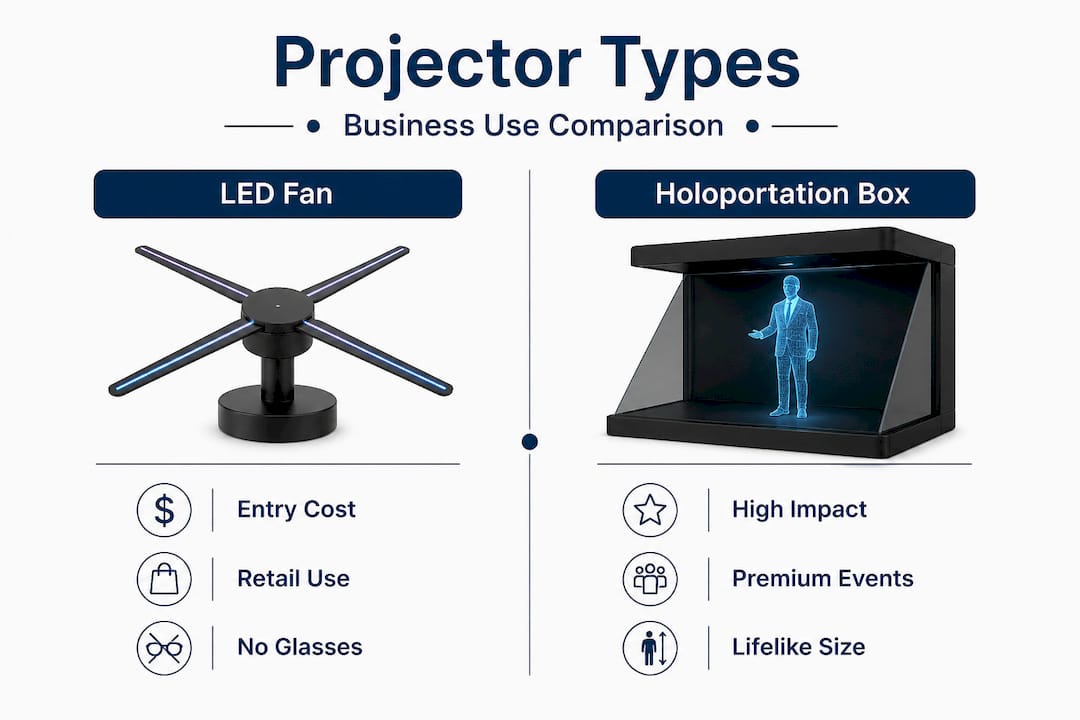
For most businesses, the LED fan and light field categories deliver the best combination of visual impact and price. You can explore holographic display branding strategies in depth to understand how these technologies translate into real brand lift.
Pro Tip: Stop evaluating these devices based on whether they are “technically” holograms. Your customers do not carry physics textbooks. They respond to the floating image, the wow moment, and the memory it creates. Perceptual impact drives purchasing behavior, not technical accuracy.
Types of hologram projectors and their business strengths
Now that you know the technology foundation, let us explore the specific projector types and what each brings to a commercial environment.
LED fan displays are the workhorse of retail holographics. They are affordable, easy to install, and can loop animated content from a USB drive or Wi-Fi connection. A single 43-centimeter fan unit can display a floating product logo, animated cocktail, or spinning sneaker in a window or above a display counter. Multiple fans can be synced to build larger composite images. They are genuinely effective for drawing foot traffic when positioned in storefront windows.
Light field displays, such as those from Looking Glass Factory, project images from up to 100 simultaneous viewing angles. This creates a more convincing sense of depth because the image actually changes as you move your head. These units work well for tabletop product demos, luxury retail showcases, or hospitality front desks where guests can view a 3D map or menu item from multiple angles without moving around the display.
Holoportation boxes represent the premium tier. The Proto Luma, for example, is an 86-inch 4K display that renders life-size figures, supports live beaming with 8ms latency, and can run AI-powered interactive avatars. At $85,000 to $120,000, it is an enterprise investment. Flagship hotel chains, high-end retail, and large venue operators are the primary buyers. Think of it as a virtual concierge or a live brand ambassador who can appear in multiple locations simultaneously.
Here is a practical comparison to guide your decision:
| Type | Visual wow factor | Content flexibility | Ideal venue size | Setup complexity |
|---|---|---|---|---|
| LED fan | High | Moderate | Small to medium | Low |
| Light field | Very high | High | Medium | Medium |
| Holoportation box | Extreme | Very high | Large | High |
Key business use cases across these types include:
-
Retail storefronts: LED fans in windows to pull in passing foot traffic
-
Menu boards and F&B: Animated food or cocktail visuals above bar counters
-
Hotel lobbies: Light field displays showing local attractions or event schedules
-
Product launches: Life-size holoportation boxes for live-streamed brand ambassadors
-
Trade shows: Portable LED fan arrays to make your booth impossible to ignore
If you want a ready-made library of ideas, the digital holographic signage use cases resource walks through format-specific applications. And if your primary goal is brand mark visibility, animated logo projectors offer a focused solution that pairs well with LED fan technology.
Key limitations and what businesses should know
Understanding the options is essential, but it is just as important to recognize practical limitations and set realistic expectations before you invest.
LED fan displays have a specific visual profile. They work best with transparent, wireframe, or lightly colored animated content. A floating neon logo, an animated bottle, or a ghost-like product silhouette looks spectacular. A dense, opaque, photorealistic object looks muddier.
Here are the most common limitations businesses encounter:
-
Content format: You need to provide pre-rendered 3D animation files, not standard video. Most vendors supply templates, but custom content takes additional budget and lead time.
-
Ambient light sensitivity: Dimmer environments consistently produce stronger visual impact. Window placements work best in the evening or in shaded indoor zones.
-
Viewing angle: LED fan units have a primary viewing cone. Moving too far to the side reduces the 3D illusion significantly.
-
True interactivity: Touchable or gesture-responsive volumetric displays are emerging technology but remain largely lab-stage. Do not budget for them expecting a reliable commercial product in 2026.
-
Maintenance: Spinning components mean mechanical wear. Units designed for 24/7 operation are available but at a higher price point.
“The businesses getting the best ROI from hologram technology are not the ones chasing technical perfection. They are the ones using perceptual impact to create memorable moments that customers share, revisit, and talk about.” That is the real benchmark. Engagement drives revenue.
Pro Tip: Use premade 3D content that is representative of your product or service. Customers just need a concept image, not the exact product brand, model, etc. to be drawn in and engage. If your application requires specific and custom made content, when briefing a content creator for your holographic display, specify your expectations of the content design. This one conversation will save you hours of back-and-forth and produce dramatically better results.
For a wider view of where projector technology fits across business categories, the breakdown of top business projector uses is worth a read before you finalize your format decision.
Real-world applications: Hologram projectors in action
Having covered the limitations, let us get practical. Here is how forward-thinking businesses are putting hologram projectors to work for real results.
The holographic display market’s 25% annual growth rate is not being driven by laboratory budgets. It is being driven by retail owners, restaurateurs, and hospitality managers who found that engagement-focused environments can lift revenue by up to 80%. These are the environments you can build.
Five business scenarios where hologram projectors deliver:
-
Storefront window displays: A mid-size clothing retailer places a pair of LED fan arrays in each window, looping a floating, animated version of their seasonal campaign imagery. Evening foot traffic stops. People photograph the window. Social posts go up without any paid promotion. Foot traffic increases measurably in the first two weeks.
-
Restaurant and bar menu launches: A hospitality group launching a new cocktail menu installs a 50-centimeter LED fan above the bar. An animated version of the signature cocktail floats above the unit, garnishes spinning slowly in a loop. Staff report that guests ask about the “floating drink” constantly, making it a natural conversation starter that drives orders.
-
Hotel check-in and lobby engagement: A boutique hotel places a light field display at the front desk showing a 3D rotating map of local attractions. Guests interact with it while waiting. It reduces perceived wait time and consistently earns mentions in online reviews as a memorable detail.
-
Trade show and event booths: A brand at a retail trade show uses a synchronized array of four LED fans above their booth to display a large animated version of their logo. In a hall full of flat screens and banner stands, the floating display draws visitors from across the floor.
Step-by-step: Launching a new menu item with holographic displays
-
Use premade 3D content that resembles your menu item, or product. Customers don’t need to see the exact product, they just need a suggestive image to engage.
-
Install an LED holographic fan display on your countertop, above the bar or near your menu board area where the item will be highlighted.
-
Load the animation to the unit and schedule it to run during peak hours.
-
Brief your staff to use the display as a conversation tool, pointing guests toward the floating item.
-
Track orders for the featured item over a four-week period and compare to your baseline. Most operators see a clear lift in orders for the highlighted item.
Staying current on format and format trends helps you make the right deployment call. The resource on projector usage trends in 2026 covers what is gaining traction this year. And if animated brand identity is a priority, animated logo display tactics offers format-specific guidance.
The surprising truth: Brand impact over technical perfection
Here is the opinion that most technology guides avoid: chasing “true” holography is a mistake for most businesses, and it always will be. Not because the technology is unimpressive, but because it solves a problem your customers do not have.
Your customer does not walk into your venue wondering whether the floating 3D image was generated by laser interference patterns or spinning LEDs. They see something unexpected, something beautiful, something that makes them stop. That is the entire job. The perceptual value of holographic displays consistently outperforms technical realism when it comes to brand visibility and customer recall.
We have seen this pattern repeatedly. Businesses that invest in “good enough” holographic technology and spend the remaining budget on quality content, smart placement, and staff engagement training outperform businesses that wait for perfect technology. Perfect technology does not exist yet at commercial price points. Practical, beautiful, engaging technology absolutely does.
The quote that captures it best: “If your goal is to stand out and engage, no one asks for a physics demo. They remember the experience.”
That is the business case. You are not buying a piece of science equipment. You are buying a tool that changes how customers perceive your space and your brand. Evaluate it that way, and the ROI math becomes much cleaner. The brand strategy with holographic displays framework we use starts from this exact premise and works outward to format, placement, and content.
Elevate your brand with the right projector solution
You now have a clear picture of what hologram projectors can do, which types fit different environments, and how leading businesses are deploying them for real results. The next step is finding the right format for your venue, your budget, and your brand identity.
Our range covers everything from entry-level animated logo projector solutions that make an immediate visual impact, to full holographic digital signage systems designed for high-traffic retail and hospitality environments. Every product we offer is built for commercial deployment, not just demonstration. If you are ready to stop blending into the background and start creating the kind of in-venue experience customers photograph and share, we have the tools to get you there.
Frequently asked questions
Are hologram projectors the same as holography?
No, commercial hologram projectors use visual tricks to simulate floating 3D images without the laser-based process of true holography, which is too costly and impractical for business use.
Can hologram projectors display any kind of content?
They work best with transparent or lightly animated visuals. LED fans struggle with opaque solids and full 360-degree viewing angles, so content design matters as much as the hardware itself.
What is the cost range for business-ready hologram projectors?
Basic but very effective LED fan units range from $200 to $2000 dollars and have a high return on customer engagement.
How do hologram projectors boost customer engagement?
They create a stop-and-stare moment that increases dwell time and drives conversation. Businesses focused on engagement-driven experiences have seen revenue lift of up to 80% compared to static display environments.
Recommended
-
What Is a Logo Projector? And Why More Businesses Are Starting to Use Them – The Logo Light Store
-
Holographic Displays: A Strategic Breakthrough in Brand Marketing – The Logo Light Store
-
Top Ways Businesses Use Logo Projectors to Stand Out in 2026 – The Logo Light Store
-
Immersive Design: A Guide to Better Customer Engagement | Journal | Almost Impossible