
Most business owners look at an LED wall and see a very large, very expensive television. That instinct is understandable, but it misses the point almost entirely. An LED wall is not a screen you hang on a wall and forget. It is a dynamic, scalable communication platform that can reshape how customers experience your brand the moment they walk through your door. This article breaks down exactly how LED walls work, how they drive real engagement in retail and hospitality settings, what they actually cost to run, and what separates businesses that get serious ROI from those that end up with an expensive piece of digital wallpaper.
Table of Contents
- What is an LED wall? The core technology explained
- How LED walls drive customer engagement in retail and hospitality
- Key components and costs: Breaking down investment considerations
- Content and control: Managing your LED wall for maximum impact
- Why LED wall success goes beyond the screen
- Level up your business impact with dynamic signage solutions
- Frequently asked questions
Key Takeaways
| Point | Details |
|---|---|
| LED wall basics | An LED wall is a modular display system that delivers brilliant, seamless visuals at any scale. |
| Business impact | LED walls drive higher customer engagement, brand visibility, and sales when used strategically in retail and hospitality. |
| Investment factors | Total cost of ownership includes both up-front hardware and ongoing operational costs like content and maintenance. |
| Content is king | Regularly updated, well-managed content maximizes the ROI of any LED wall installation. |
What is an LED wall? The core technology explained
At its most basic level, an LED wall is a large-format display built from multiple modular panels that connect together to form one seamless image. Each panel contains thousands of tightly packed RGB (red, green, blue) LED diodes. By controlling the intensity of each diode, the system generates the full color spectrum with remarkable brightness and clarity, even in environments with strong ambient light like a sunlit retail floor or a brightly lit hotel lobby.
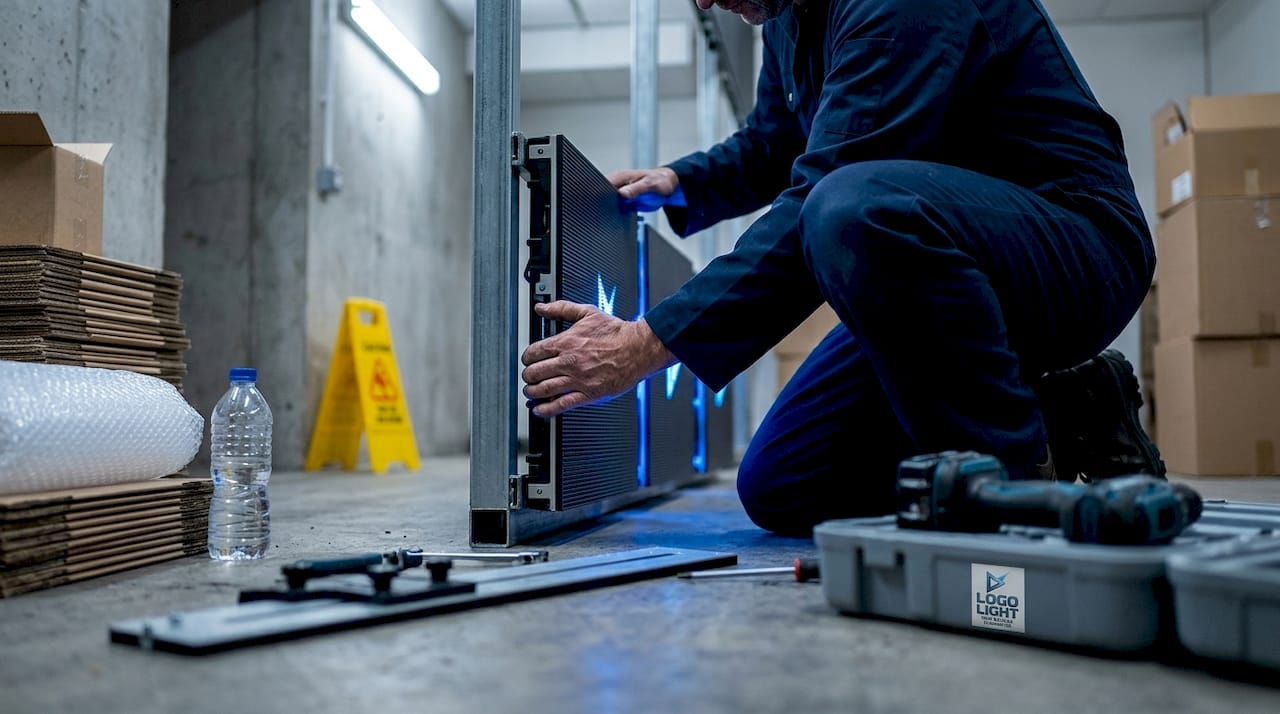
What separates an LED wall from a consumer television is not just size. It is the underlying architecture. LED video wall systems rely on panels and modules paired with video processing controllers to drive the display, using RGB diodes whose intensities generate every color in the image. That processing layer is critical. Without it, you would have panels that glow but display nothing coherent. The controller takes your video signal, maps it across all connected panels, and ensures that the image remains consistent, synchronized, and sharp regardless of the display’s total size.
Here is a quick comparison to help put the technology in context:
| Feature | LED wall | Commercial TV |
|---|---|---|
| Scalability | Virtually unlimited | Fixed size |
| Brightness (nits) | 1,000 to 10,000+ | 300 to 700 |
| Viewing angle | Wide, up to 160 degrees | Narrower |
| Ambient light performance | Excellent | Moderate |
| Modular repair | Yes, panel by panel | No |
| Lifespan | 100,000+ hours | 30,000 to 60,000 hours |
“The ability to scale an LED wall to almost any dimension while maintaining image fidelity makes it fundamentally different from any fixed-size display technology available to commercial buyers today.”
That modularity also means you can repair a single panel rather than replacing the entire display, which has significant long-term cost implications. Businesses exploring projection-based branding alongside LED walls will find that solutions like custom projector applications offer complementary ways to extend visual branding into spaces where a full LED wall installation is not practical.
How LED walls drive customer engagement in retail and hospitality
Understanding the technology is step one. The real question for any business owner is: what does this actually do for my customers and my bottom line?
The short answer is that LED walls command attention in a way that static signage simply cannot. In a busy retail environment or a hotel lobby with dozens of competing visual elements, a large-format dynamic display acts as a natural focal point. Human vision is wired to respond to motion and light contrast, which means a well-placed LED wall with moving content will draw eyes before a printed banner ever will.
Here is how businesses in retail and hospitality are using LED walls right now:
- Retail product launches: A full-wall visual behind a featured product creates an immersive moment that stops shoppers mid-stride and encourages them to engage with the merchandise.
- Sale and promotion notifications: Pricing and promotional content can be updated instantly across multiple locations without printing or shipping new materials.
- Ambiance creation: In hospitality settings, LED walls can shift the entire mood of a space, from a calm morning palette in a hotel breakfast area to a vibrant evening atmosphere in a bar or event venue.
- Event backdrops: Conferences, weddings, and corporate events hosted in hotels benefit enormously from branded LED backdrops that elevate the perceived value of the space.
- Digital menus: Restaurants and cafes use LED walls to display dynamic menus that can be updated in real time to reflect availability, pricing, or daily specials.
The performance of an LED wall depends not just on the hardware but on ongoing operational factors including scheduling, content updates, and total cost of ownership. Businesses that treat their LED wall like a set-it-and-forget-it installation quickly see engagement drop. Those that treat it like a live marketing channel see sustained results.
Pairing your LED wall strategy with other visibility tools like logo projectors for brand differentiation can extend your brand presence beyond the walls of your space and into the street-level visibility that drives foot traffic. And if you are still weighing whether illuminated signage is worth the investment, the data on illuminated signs and sales performance makes a compelling case for any customer-facing business.
Pro Tip: Schedule your LED wall content in at least three distinct blocks throughout the day: morning, afternoon, and evening. Tailor each block to the customer behavior typical of that time. A coffee shop might show breakfast specials at 8 a.m., productivity content at noon, and happy hour promotions by 4 p.m. Repeat customers notice when content is fresh, and that freshness signals a business that is active and attentive.
Engagement stat worth noting: Digital signage has been shown to capture significantly more attention than static displays in high-traffic commercial environments, with motion-based content consistently outperforming still images in recall and dwell time studies across retail sectors.
Key components and costs: Breaking down investment considerations
One of the biggest mistakes business owners make when budgeting for an LED wall is focusing only on the panel cost. The panels are just one part of a system that includes several other critical components, each of which adds to the total investment.
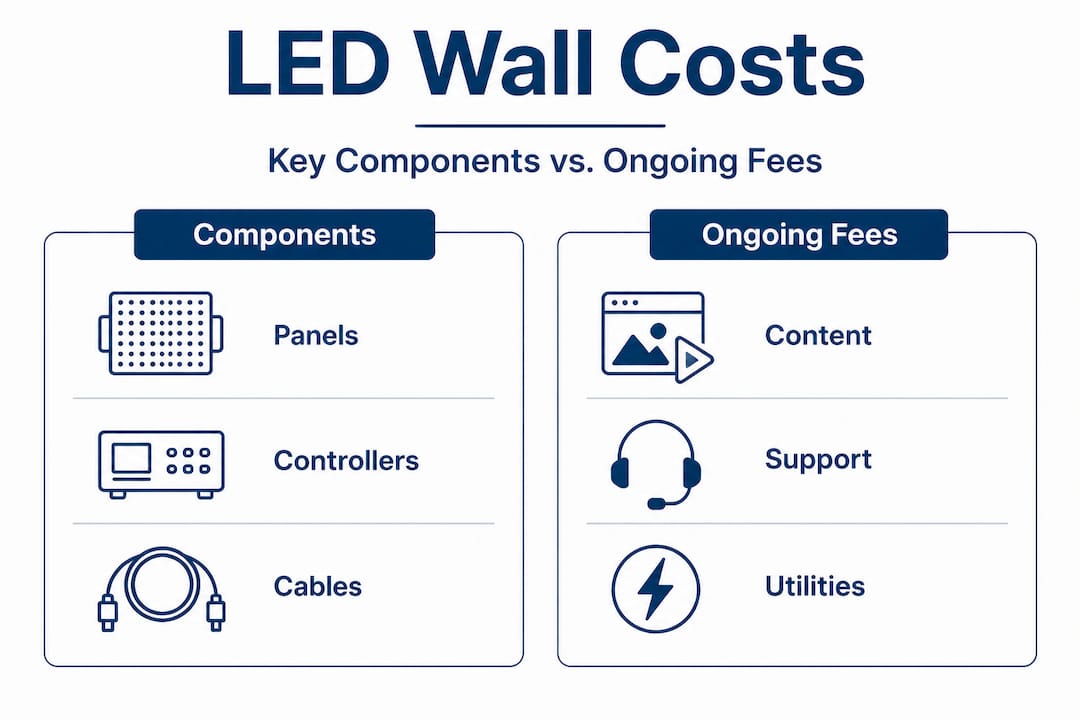
Here is a breakdown of the major cost categories:
| Cost category | What it covers | Notes |
|---|---|---|
| Panels and modules | The physical display tiles | Price varies by pixel pitch and brand |
| Video processor/controller | Signal management and image mapping | Often underestimated in budgets |
| Mounting and structure | Wall mounts, rigging, or freestanding frames | Depends heavily on installation environment |
| Cabling and connectivity | Power, data, and signal cables | Can be significant for large installations |
| Content management software | Scheduling, remote updates, and monitoring | Ongoing subscription or one-time license |
| Electricity | Operational power draw | Higher brightness means higher power use |
| Maintenance and support | Cleaning, component checks, repair contracts | Often overlooked until something breaks |
The total cost of ownership for LED wall systems goes well beyond the hardware purchase, encompassing processors, controllers, scheduling infrastructure, and ongoing operational management. A business that budgets only for panels and installation often finds itself surprised by the ongoing costs of keeping the system running effectively.
Here is a five-step guide to estimating your LED wall investment accurately:
- Define your display goals. Determine the size, location, viewing distance, and primary use case before looking at any hardware. A 2mm pixel pitch panel is unnecessary if your audience is 15 feet away.
- Get a full system quote. Ask vendors to itemize panels, processors, mounting, cabling, and software separately so you can compare apples to apples across suppliers.
- Calculate operational costs. Estimate monthly electricity costs based on the display’s power draw, and factor in content management software fees if applicable.
- Plan for content creation. Budget for ongoing design work or an internal content calendar. An LED wall without fresh content is an expensive static sign.
- Negotiate post-install support. Confirm warranty terms, response times for panel failures, and whether remote diagnostics are included before signing any contract.
For businesses exploring more affordable entry points into dynamic digital signage, animated logo video projectors offer a lower-cost way to introduce motion-based branding, while wirelessly managed shelf displays provide targeted product-level digital signage without the full LED wall commitment.
Content and control: Managing your LED wall for maximum impact
You have the hardware. Now what? The businesses that consistently get the most out of their LED walls are not the ones with the biggest panels or the highest resolution. They are the ones with a disciplined, ongoing approach to content management.
Modern LED wall controllers allow remote scheduling and instant content changes through software interfaces that most non-technical staff can learn in an afternoon. That accessibility is a major advantage. You do not need an IT team to swap out a promotional graphic or update a menu price. The operational flexibility of LED wall systems is one of their most underappreciated features.
Best practices for content management include:
- Mix content types. Alternate between brand storytelling, active promotions, and ambiance visuals. A wall that only shows sale prices starts to feel like a clearance rack.
- Use time-based scheduling. Program different content for different dayparts, days of the week, or seasonal periods. This keeps the display relevant without requiring daily manual intervention.
- Maintain brand consistency. Every piece of content should reflect your brand’s color palette, typography, and tone. An LED wall that looks like a patchwork of unrelated graphics undermines the professionalism it is supposed to project.
- Test and measure. If your point-of-sale system allows it, track whether promotions displayed on the LED wall generate measurable lift in sales during their scheduled periods.
The most common pitfall is what we call the “digital wallpaper” effect. This happens when a business installs an LED wall, loads it with content on day one, and then never updates it again. Within weeks, regular customers stop noticing it. The display becomes background noise. Ongoing content updates and scheduling are not optional extras in an LED wall strategy. They are the core of what makes the investment work.
Pro Tip: Build a simple monthly content refresh workflow. Assign one person to own the LED wall content calendar, set a recurring reminder to review and update content on the first of each month, and keep a library of pre-approved brand assets ready to deploy. This takes less than two hours a month and prevents the digital wallpaper problem entirely.
Why LED wall success goes beyond the screen
Here is the perspective that most vendors will not give you: the screen itself is almost never the reason an LED wall succeeds or fails. We have seen businesses install stunning, high-resolution LED walls in prime locations and generate almost no measurable return. We have also seen modest installations in secondary spaces drive consistent engagement and sales lift. The difference is never the hardware.
The real determinants of LED wall ROI are operational: how the system is managed, how often content is refreshed, and whether the staff who interact with customers understand how to leverage what is on the screen. A well-trained floor associate who can reference a promotion currently displayed on the LED wall behind them is doing something no amount of pixel pitch can replicate.
The businesses that treat their LED wall as a marketing campaign, with a content strategy, a refresh schedule, and performance metrics, consistently outperform those that treat it as infrastructure. Infrastructure gets installed and forgotten. Campaigns get managed, optimized, and improved. That mindset shift is the single most valuable thing any business owner can take away from this topic.
Think about building brand memory as the real goal. An LED wall that consistently shows relevant, on-brand content trains your customers to associate your space with quality and attentiveness. That association is worth far more than any single promotional conversion it might drive.
Level up your business impact with dynamic signage solutions
Ready to move from understanding to action? Whether you are planning a full LED wall installation or looking for dynamic signage solutions that fit a tighter budget or a specific use case, the right starting point is exploring what modern display technology can actually do for your space.
Our range of animated logo video projectors gives businesses a high-impact, motion-based branding tool that works alongside or independently of larger LED installations. For businesses looking to build a cohesive visual identity across every customer touchpoint, our rotating logo projector collection offers flexible, scalable options that complement any signage strategy. Explore the full range and connect with our team to find the right combination of display solutions for your specific space, goals, and budget.
Frequently asked questions
How is an LED wall different from a traditional TV display?
LED video wall systems use modular panels and advanced controllers to create scalable, seamless displays built for commercial environments, while TVs are fixed-size consumer products with limited brightness and no modular expansion capability.
What maintenance is required for an LED wall?
LED walls need periodic cleaning, occasional panel and component checks, and regular content updates to remain effective, since operational upkeep is as important as physical maintenance for long-term performance.
How do I update content on an LED wall?
Most modern LED wall controllers support remote and scheduled content updates through straightforward software interfaces that do not require technical expertise to operate on a daily basis.
What types of businesses benefit most from LED walls?
Retailers and hospitality venues are the primary beneficiaries, using LED walls in commercial spaces to increase customer engagement, highlight time-sensitive promotions, and create immersive brand experiences that static signage cannot match.
Recommended
- Logo Signs for Business That Attract Customers | Logo Light™
- Top Ways Businesses Use Logo Projectors to Stand Out in 2026 – The Logo Light Store
- Top Ten Impactful Business Uses for Custom Logo Projectors – The Logo Light Store
- Do Illuminated Business Signs Increase Sales? A Data-Driven Guide for Storefront Businesses