
Most restaurant and retail owners assume digital branding means having a logo on Instagram and a halfway-decent website. That assumption is costing them customers every single day. Digital branding is actually the process of creating and maintaining a consistent, recognizable brand identity across every digital channel your customers touch, from search results and social feeds to the digital menu board hanging above your counter. This guide breaks down exactly what that looks like in practice, gives you a framework you can act on today, and shows you where most businesses quietly go wrong.
Table of Contents
- Defining digital branding: More than a logo
- The pillars of digital branding strategy
- Digital branding in action: How restaurants and retailers win
- Measuring and optimizing digital brand health
- Why most businesses misunderstand digital branding (and what actually works)
- Level up your branding with innovative digital signage solutions
- Frequently asked questions
Key Takeaways
| Point | Details |
|---|---|
| Definition matters | Digital branding is a strategic, ongoing process that goes far beyond just having an online logo. |
| Foundations first | Business success with digital branding starts by clarifying your mission, voice, and visual identity before executing tactics. |
| Channel selection is critical | Different digital channels—including signage, websites, and social media—play unique roles in branding for restaurants and retail. |
| Measure and adapt | Use engagement metrics and real-world data to refine your digital brand for maximum impact and ROI. |
| In-store and online synergy | Digital signage boosts brand memory and drives conversions when seamlessly aligned with your full digital branding strategy. |
Defining digital branding: More than a logo
Digital branding is not a single tactic. It is an organized, ongoing process of building and communicating your business’s identity everywhere your audience encounters you online or on-screen. That includes your website, your social media profiles, your search presence, your email marketing, your digital signage, and even emerging AI-driven discovery platforms where customers are increasingly finding businesses before they ever visit in person.
Here is where most restaurant and retail owners get tripped up. They treat branding as a one-time design project: pick a logo, choose a color palette, print some menus, done. But a traditional branding exercise is static. Digital branding is dynamic. It responds to audience behavior, adapts to platform changes, and requires ongoing measurement to stay effective.
What makes digital branding fundamentally different from traditional approaches comes down to three things:
- Audience targeting: You can reach exactly the right customer at the right moment, not just a broad geographic area.
- Measurability: Every interaction can be tracked, from a click on your menu page to a customer pausing in front of your digital display.
- Interactivity: Customers can respond, share, review, and engage with your brand in real time, creating feedback loops that paper signage never could.
“A brand is no longer what we tell the consumer it is. It is what consumers tell each other it is.” This is precisely why digital branding demands a proactive, consistent strategy rather than a passive one.
For physical businesses like restaurants and retailers, digital branding also means connecting your on-premise experience to your online presence seamlessly. The brand recognition basics that drive customers through your door are the same ones reinforced when they see your branded digital signage, your consistent Instagram grid, and your Google Business profile using the same visual language.
The pillars of digital branding strategy
Now that you understand the full scope of digital branding, let us get into the structural foundations that actually make it work. Think of these as the load-bearing walls of your brand. Remove any one of them and the whole structure gets unstable.
Brand foundations come first. Before you invest in a single pixel of design work or launch any campaign, you need to define your mission, your target audience, your brand personality, your unique value proposition (UVP), and your brand voice. These decisions inform everything else. Skipping this step is like designing your restaurant’s interior before deciding what cuisine you serve. As research on digital brand management confirms, core methodologies always start with defining brand foundations including mission, audience, personality, UVP, and voice before moving into visual execution or channel strategy.
Visual consistency is non-negotiable. Your logo, color palette, and typography need to look the same whether a customer finds you on Google, sees your Instagram story, or walks past your storefront window display. Inconsistency sends a subconscious signal that something is off. Customers may not be able to name what bothers them, but they will trust you less. Your visual identity should be documented in a simple brand guide that every team member, designer, and signage vendor follows without question.
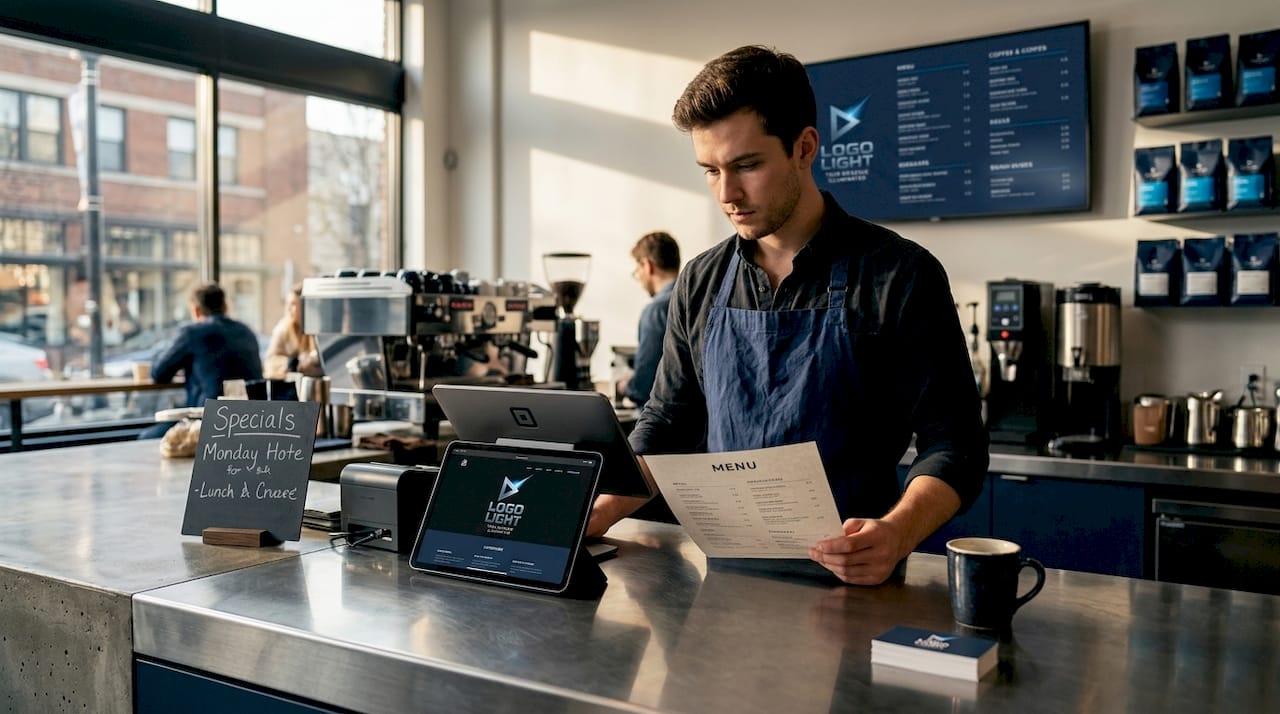
Content mix matters more than most owners realize. The strongest digital brands publish three types of content: educational content that proves expertise, authority content that builds credibility, and storytelling content that creates emotional connection. For a restaurant, this might look like recipe tips on social, a press mention on your website, and behind-the-scenes kitchen videos on Instagram. For a retailer, it could be product guides, staff recommendations, and customer stories. A smart content strategy does not just fill your feed, it builds trust over time.
Trust signals close the deal. Reviews, certifications, press mentions, and recognizable visual cues like consistent branded signage all act as shortcuts for customer trust. When a first-time visitor sees your Google reviews are strong, your website looks polished, and your in-store displays match the brand they researched online, the conversion from curious to committed happens much faster.
Here is a quick breakdown of the core pillars and how they map to your channels:
| Pillar | Primary channels | Key metric |
|---|---|---|
| Brand foundations | All channels | Consistency score |
| Visual identity | Website, signage, social | Recognition rate |
| Content strategy | Social, blog, email | Engagement rate |
| Trust signals | Google, reviews, in-store | Conversion rate |
| Data-driven iteration | Analytics, POS data | Growth over time |
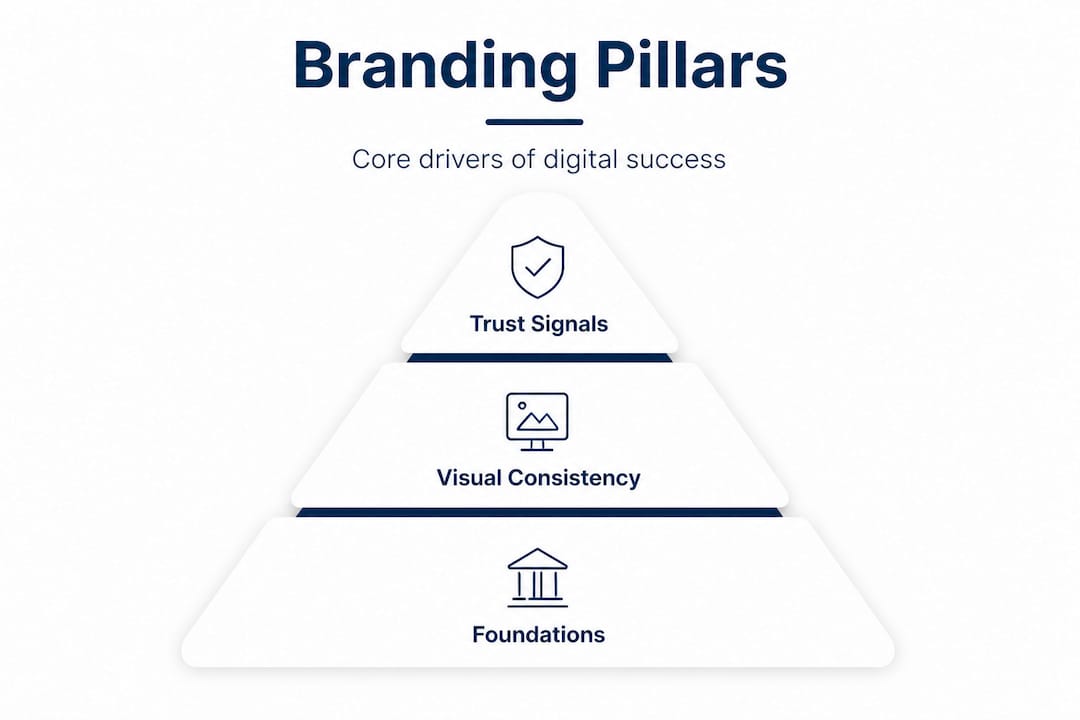
As branding research consistently shows, brands that prioritize foundations before digital execution avoid the expensive inconsistency that forces costly rebrands later. Businesses that jump straight to running paid ads or installing signage without a defined brand voice often end up with fragmented customer experiences that confuse rather than convert.
Pro Tip: Take your most recent social post, your website homepage, and a photo of your in-store signage. Put them side by side. If they do not look like they belong to the same brand, you have a consistency problem that no ad spend will fix.
Reviewing branding success stories from businesses that have aligned their on-premise and online visual identity reveals a common theme: consistency is what separates forgettable brands from ones that customers mention to their friends.
Digital branding in action: How restaurants and retailers win
Knowing the pillars is one thing. Seeing how they translate into real decisions for a restaurant or retail shop is where the strategy gets exciting. Let us look at channel selection and integration.
Websites function as your authority hub. This is where customers come to verify you are legitimate, check your menu or product catalog, and decide whether to visit or buy. Your website should reflect your brand identity completely and load fast on mobile since most local searches happen on phones.
Instagram and social platforms are your engagement engines. These channels build community, humanity, and daily brand presence. The visual nature of both restaurants and retail makes social media an especially powerful channel. Short video content, product highlights, and team moments all reinforce brand personality in ways a menu or product shelf cannot.
Digital signage is your owned media, and it is wildly underused by most local businesses. Unlike social media where algorithms control who sees your content, digital signage in your space reaches every single customer who walks through your door. Channel-specific execution research confirms that using digital signage as owned media, especially with point-of-sale (POS) integration, creates measurable, controllable ROI that is impossible to replicate with rented media like social ads.
Here is a practical comparison of how digital and traditional branding perform across key restaurant and retail goals:
| Goal | Digital branding | Traditional branding |
|---|---|---|
| Reach new local customers | Targeted search and social ads | Flyers, local print ads |
| Build brand recognition | Consistent visuals across all touchpoints | Static signage, printed materials |
| Drive repeat visits | Email campaigns, loyalty apps, social | Punch cards, word of mouth |
| Measure effectiveness | Real-time analytics and POS data | Difficult to track accurately |
| React to trends | Instant updates to digital signage and posts | Slow, expensive to change |
To actually put this into practice, here are the steps that work best for restaurant and retail businesses getting serious about digital branding:
- Audit every customer touchpoint and identify where your brand looks inconsistent.
- Define or refine your brand foundations before touching any visual assets.
- Create a simple one-page brand guide covering logo use, colors, fonts, and voice.
- Update your website, social profiles, and Google Business listing to match.
- Install or upgrade in-store digital signage to carry your visual identity on-premise.
- Integrate your signage with your POS system for real-time promotions and brand alignment.
- Track results by channel and adjust based on what drives actual customer actions.
Looking at real-world branding examples shows that businesses combining physical signage updates with online brand refreshes see stronger results than those who only invest in one channel alone.
Pro Tip: After launching any new signage or digital campaign, check your Google Analytics bounce rate and your POS transaction data for the same period. A drop in bounce rate paired with an uptick in transactions is one of the clearest signals that your brand update is working.
For social media best practices specific to local businesses, keeping content authentic and locally relevant almost always outperforms polished, generic content that feels disconnected from the actual store experience.
Measuring and optimizing digital brand health
Getting your digital branding right is not a one-time achievement. It is an ongoing cycle of measuring, learning, and improving. Here are the metrics that actually tell you whether your brand is healthy and growing.
- Search volume growth: Are more people searching for your business name specifically? Branded search growth is one of the clearest signals that awareness is building.
- Engagement rate: On social platforms, engagement (likes, comments, shares, saves) measures how much your content resonates with your audience.
- Brand mentions: Are customers tagging you, reviewing you, or talking about you online? Monitoring this reveals organic brand reach.
- Bounce rate on your website: A high bounce rate often signals a gap between what your brand promises online and what your website actually delivers.
- In-store actions: Using POS data alongside your digital analytics helps you connect online brand efforts to real purchases.
As research on branding and digital strategy makes clear, strong digital brands leverage trust signals and emotional connections to build loyalty, and high bounce rates are a reliable diagnostic signal for brand expectation gaps. When a customer clicks your ad expecting a premium dining experience and lands on a website that looks outdated, the mismatch destroys trust instantly.
Tracking key metrics like search volume growth and engagement gives you the feedback loop to iterate intelligently rather than guessing. The brands that win long-term are not the ones who get branding perfect on day one. They are the ones who measure consistently and adjust quickly.
For a deeper look at analyzing signage ROI and how physical displays contribute to measurable brand performance, the data consistently shows that in-store branded displays contribute to purchase decisions even when the initial discovery happened online. And for businesses exploring advanced display strategies, holographic signage is proving to be a standout format for capturing attention in high-traffic retail and dining environments.
Understanding the broader digital strategy fundamentals behind these measurement practices helps you build a branding operation that gets smarter over time rather than more expensive.
Why most businesses misunderstand digital branding (and what actually works)
Here is the uncomfortable truth we have seen repeated across restaurants and retail shops of every size: most businesses start with tools and never get around to strategy. They buy digital signage before deciding what the signs should communicate. They run Instagram ads before defining who they are speaking to. They invest in a new logo before understanding why customers should care about their brand at all.
Copying big-brand tactics is the other common trap. A national fast-food chain runs a viral social campaign with a seven-figure production budget. A local burger shop sees it and tries to replicate the format with a phone and a ring light. The result is content that feels like a bad imitation rather than an authentic brand expression. Local businesses win by being local, not by trying to look like everyone else.
The overlooked opportunity for most restaurants and retailers sits in owned media, specifically in-store digital signage. Unlike social media platforms that can change their algorithm overnight or paid ads that stop the moment your budget runs out, digital signage in your own space gives you complete control. You own the audience. You control the message. You can update it in real time. And you can measure its direct impact on sales through POS integration.
As branding research confirms, the businesses that build durable brand equity always prioritize foundations before execution. They know who they are before they spend a dollar on signage or ads. That clarity makes every subsequent investment more effective.
The brand memory insights behind logo projection and branded display also reveal something counterintuitive: customers remember experiences more vividly than messages. A beautifully projected logo at your entrance creates a memory anchor that a social post simply cannot match.
Pro Tip: Always measure the effect of any branding change on both your digital analytics and your in-person customer journey. If you update your signage but do not check whether dwell time or average order value changed, you are flying blind.
Level up your branding with innovative digital signage solutions
Great digital branding does not stop at your website or social profiles. It walks through your front door with every customer.
At Logo Light Store, we build the physical brand touchpoints that make your digital identity real in the room. Our animated logo projectors turn your brand mark into a captivating on-premise experience that customers notice and remember. Our rotating logo sign displays give storefronts and dining rooms a premium, polished look that reinforces your brand identity at the exact moment of decision. And our holographic digital signage solutions help forward-thinking restaurants and retailers create the kind of in-store brand moments that end up on customer social feeds. Explore our full product range and start building a brand presence your customers cannot ignore.
Frequently asked questions
What are the essential elements of a digital brand?
A digital brand requires a consistent logo, brand voice, defined mission, visual style, and clear trust signals across all digital platforms. According to digital brand management research, core elements always include brand foundations, visual consistency, content strategy, channel-specific execution, and data-driven iteration.
How does digital branding help increase in-store sales?
Digital branding builds online awareness and directs targeted audiences to physical locations, increasing foot traffic and loyalty. Research on digital vs. traditional branding shows that a roughly 60/40 split between brand building and demand generation drives both long-term equity and short-term sales performance.
What is the difference between digital and traditional branding?
Digital branding relies on interactive, measurable online channels, while traditional branding uses broader, less targeted methods like print and TV. As studies on integrated branding approaches show, the strongest results come from combining both into a hybrid strategy.
How should restaurants and retailers start a digital branding initiative?
Begin by defining your unique brand foundations, then roll out consistent visuals and campaigns across digital channels and in-store signage. Sound branding strategy confirms that skipping the foundations phase almost always leads to costly inconsistency down the road.
What metrics matter most for tracking digital brand success?
Key metrics include engagement, search volume growth, customer reviews, and real-world actions like purchases or reservations. Brand performance tracking research identifies search volume growth and channel engagement as the two most reliable early indicators of brand health.
Recommended
- Top Ways Businesses Use Logo Projectors to Stand Out in 2026 – The Logo Light Store
- Effective Business Logo Signs That Increase Sales – The Logo Light Store
- Brand Memory: How Logo Projectors Increase Recognition and Sales – The Logo Light Store
- Top Ten Impactful Business Uses for Custom Logo Projectors – The Logo Light Store
- How to boost brand visibility with digital ad automation – Palmador Blog
- Branding in the digital age: the SME growth driver