
Printed signs were once enough to pull customers through the door. That era is over. Foot traffic today is driven by visibility, motion, and memorable branding — and static printed signs simply cannot compete with the brightness, flexibility, and visual impact of modern LED signage. Whether you operate a restaurant, boutique hotel, retail shop, or service business, understanding LED signage is no longer optional. This guide explains exactly what LED signage is, how it works, which types are available, and how to use it to measurably grow your business.
Table of Contents
- What is LED signage?
- How does LED signage work?
- Types of LED signage and key comparisons
- How LED signage drives business results
- Practical tips for choosing and using LED signage
- Why most businesses underestimate the ROI of LED signage
- Explore LED signage solutions for your business
- Frequently asked questions
Key Takeaways
| Point | Details |
|---|---|
| LED signage defined | LED signage uses light-emitting diodes for clear, vibrant branding and information displays. |
| Business impact | Switching to LED signage leads to higher visibility, stronger branding, and increased customer engagement. |
| Multiple types available | You can choose from static, digital, animated, and holographic options for your specific needs. |
| Smart investment | LED signage offers lower long-term costs and higher flexibility compared to traditional signs. |
What is LED signage?
LED signage uses light-emitting diodes (LEDs) to display messages, logos, images, or animations with high brightness and exceptional clarity. Unlike a printed banner or a static window decal, LED signage is powered, programmable, and visible in nearly every lighting condition — day or night.
You will encounter LED signage in nearly every commercial environment:
- Storefront LED signs showing business names or open/closed status
- Digital menu boards in restaurants, cafes, and food halls
- Animated logo projectors casting branded visuals onto floors, walls, or entryways
- Holographic displays floating product visuals in mid-air for maximum attention
- Shelf edge displays highlighting products at point of sale
- LED walls creating immersive backdrops in lobbies or event spaces
The core difference between LED signage and traditional printed signage is the ability to change. A printed sign says one thing, forever. An LED sign can say something different every hour, every day, or in real time response to your promotions, inventory, or events.
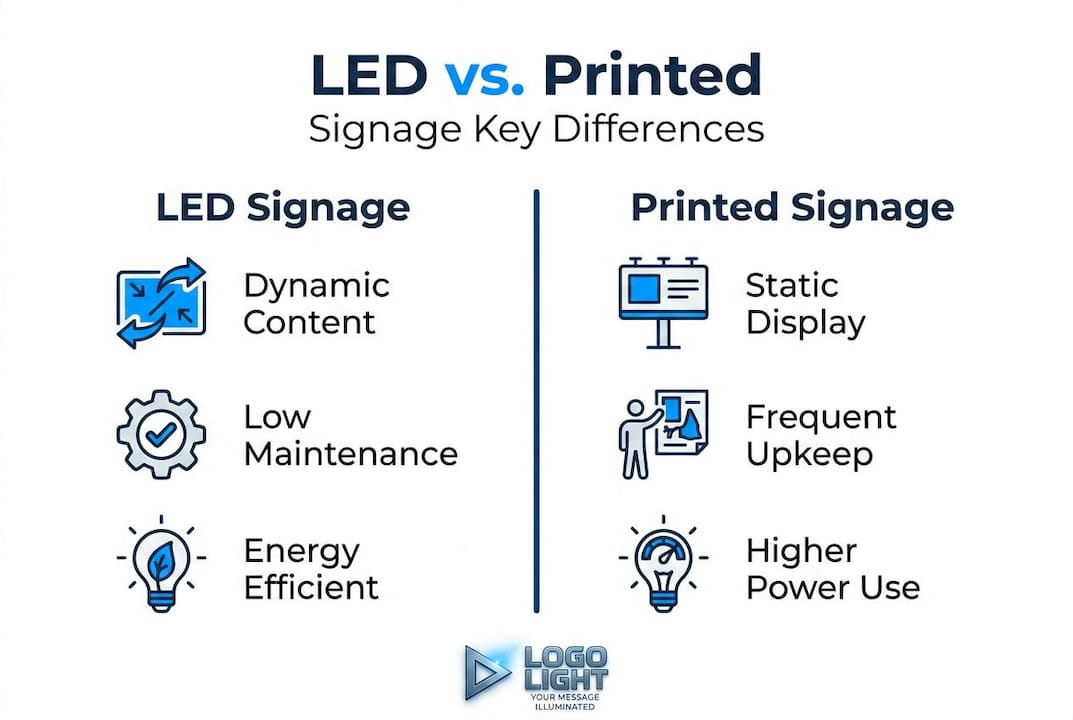
LEDs themselves are tiny semiconductor chips that emit light when electricity passes through them. They consume far less power than older neon or fluorescent tube signs, last significantly longer, and produce brighter output with truer color accuracy. For business owners, this translates directly to lower energy bills, reduced replacement costs, and far more visual impact.
As LED walls explained in depth, the shift from printed to digital signage is not just a tech upgrade. It is a fundamentally different way to communicate with customers at every touchpoint.
How does LED signage work?
LED signage works by arranging thousands of individual LED modules into a grid or panel. Each module lights up in a specific color and brightness level, and together they form images, text, animations, or video just like pixels on a screen.
Here is a typical setup process for a business installing LED signage for the first time:
- Choose your display type — wall-mounted panel, projector, holographic unit, or shelf display — based on your space and goals.
- Connect to a media player or controller — most modern LED signs include a dedicated media player, a smart controller, or connect via Wi-Fi to a cloud-based content management system (CMS).
- Upload your content — logos, promotional graphics, video loops, or menu items are uploaded through software, often as simple as drag-and-drop.
- Set your schedule — many systems allow you to automate content changes by time of day, day of week, or special events.
- Go live — the sign runs continuously, updating automatically based on your schedule or manual adjustments.
One major advantage is how little hands-on maintenance is required. Traditional illuminated signs with fluorescent tubes or neon gas need regular replacement of bulbs and ballasts. LED signs, by contrast, have no fragile tubes or gas-filled chambers. The components are solid-state, meaning they are far more durable and resistant to vibration, temperature changes, and general wear.
Pro Tip: When setting up content for the first time, keep your initial messaging simple. A clean, bold logo animation or a single strong promotional message will outperform a busy, cluttered design every time. As your team gets comfortable with the system, you can add complexity.
For businesses looking to build a strong brand presence, effective logo signs start with thoughtful content design, not just the hardware. Invest time in your visuals before launch and the results will follow.
Types of LED signage and key comparisons
Choosing the right LED signage comes down to matching the display type to your specific business environment, audience, and goals. Here is a breakdown of the most common types and where each performs best.
| Type | Best use case | Content flexibility | Wow factor |
|---|---|---|---|
| Static LED sign | Open/closed, logos, hours | Low | Moderate |
| Digital display board | Menus, promotions, events | High | Moderate |
| Animated logo projector | Entryways, floors, walls | Medium | Very high |
| Holographic display | Product showcases, retail windows | High | Exceptional |
| Shelf edge display | Point-of-sale, product highlights | Medium | Moderate |
Static LED signs are the entry point for most businesses. They display a fixed message or logo with high brightness. Simple, reliable, and cost-effective. Great for visibility but limited when it comes to promotions or seasonal messaging.
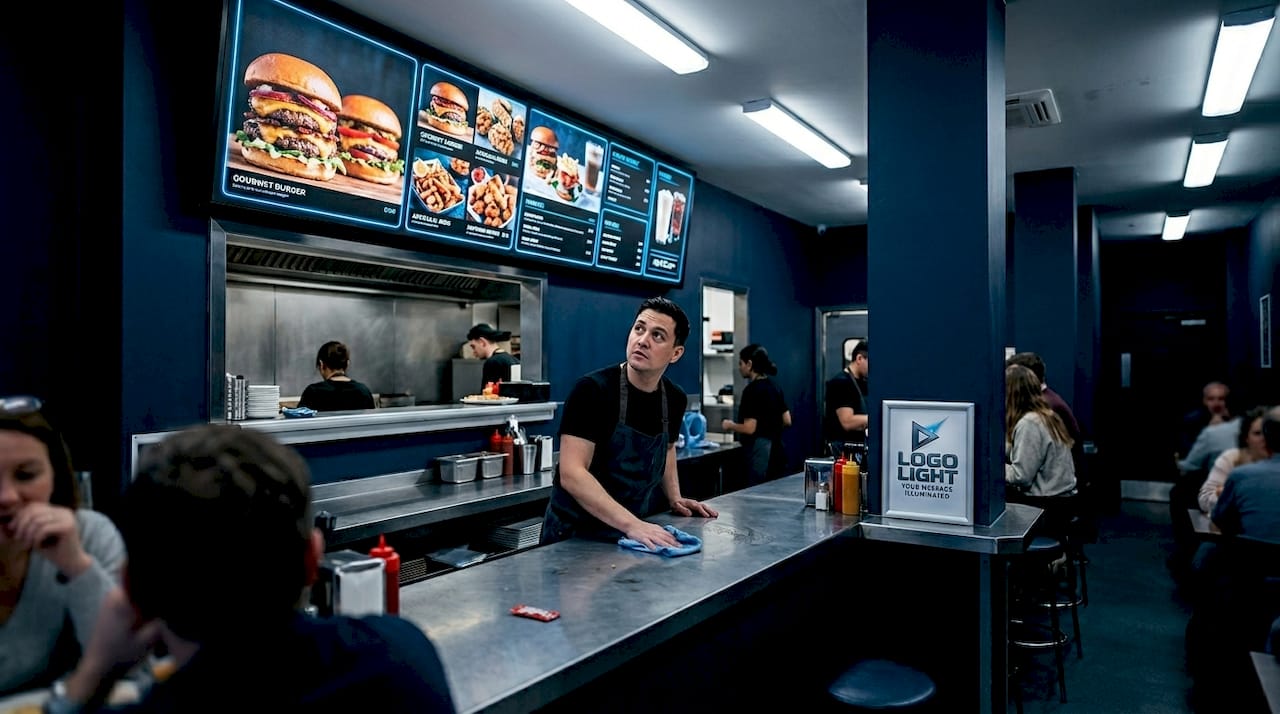
Digital display boards are the workhorses of LED signage. Restaurants use them as digital menu boards. Retailers use them to rotate promotions. Hotels use them for event schedules. The ability to update content remotely from a phone or laptop makes these signs incredibly versatile.
Animated logo projectors are where things get genuinely exciting. These units project your brand’s logo or a custom animation onto a floor, wall, or exterior surface. The movement instantly captures attention in ways that static signs cannot. A hotel entrance with a rotating animated logo on the floor creates a premium first impression. A bar with a projected logo on the sidewalk stops foot traffic before anyone even reads a sign. You can explore ways to use logo projectors in virtually any commercial setting.
Holographic displays represent the leading edge of retail signage technology. These units use light diffusion panels or fan-based LED arrays to create floating 3D visuals. No screens, no frames, just a glowing image appearing in space. The impact on passersby is immediate and memorable. Luxury retail, automotive showrooms, and hospitality venues are early adopters, but costs are dropping fast.
Statistic callout: According to industry research, digital out-of-home signage generates over 400% more views per dollar spent compared to static printed formats. For businesses in high-foot-traffic locations, that is a ratio that is difficult to ignore.
How LED signage drives business results
The business case for LED signage goes well beyond aesthetics. The numbers behind customer behavior tell a clear story about why this investment pays off.
Movement and color are biologically hardwired to attract human attention. Our peripheral vision is specifically tuned to detect motion, which means an animated LED sign will catch a customer’s eye before they have even consciously decided to look at it. That split-second advantage compounds over thousands of daily impressions.
Consider these documented benefits for businesses that make the switch:
- Higher walk-in traffic — businesses report meaningful increases in foot traffic after installing illuminated or animated signage, particularly in competitive retail corridors
- Better message recall — customers remember dynamic visual content significantly better than static text
- Real-time promotion capability — flash a lunch special at 11am, a happy hour deal at 4pm, and a weekend event on Friday afternoons, all from the same display
- Stronger brand identity — consistent logo display, color accuracy, and animation quality reinforce brand recognition every time someone walks past
- Extended visibility hours — an LED sign is just as bright at 10pm as it is at noon, keeping your business visible long after your competitors’ signs fade into the background
“LED signage increases customer engagement and sales when businesses commit to consistent, on-brand visual content. The display is only as powerful as the message it carries.” — illuminated signs increase sales
The connection between visual branding and revenue is well documented. Brand memory and sales are directly linked: when customers recognize your logo and associate it with a consistent experience, they return more often and spend more per visit. LED signage is one of the most efficient tools for building that recognition at scale.
Looking at retail display trends shows that businesses investing in dynamic displays consistently outperform those relying on static printed materials. Digital signage case studies across industries reinforce this pattern: the brands that control their visual environment control the customer experience.
Practical tips for choosing and using LED signage
After seeing the evidence of what LED signage can do, the next step is making smart choices about how to deploy it in your specific business. Here is a practical framework to get it right.
- Define your primary goal first. Are you trying to attract new foot traffic from the street? Reinforce your brand inside the store? Promote rotating specials? Each goal points toward a different sign type and placement strategy.
- Prioritize visibility over volume. One well-placed, high-quality LED sign in the right location will outperform five mediocre signs scattered around a space. Map your customers’ sightlines from the street, from the entrance, and from the point of sale.
- Match sign type to audience expectations. A fine dining restaurant benefits from a sophisticated animated projector at the entrance. A fast-casual spot needs a clear, bright digital menu board above the counter. Know what your customer expects before choosing your format.
- Keep content simple and on brand. The biggest mistake businesses make with digital signage is overloading it with text. Your sign has roughly three seconds to make an impression. Bold visuals, your logo, and one clear message will always outperform a scrolling wall of information.
- Schedule regular content updates. A digital menu board showing last season’s specials actively damages your brand. Build a monthly or weekly review into your operations so the content stays fresh, accurate, and relevant.
Pro Tip: Before locking in placement, stand where your customers stand. Walk the approach to your entrance. Sit at your most common table. Check sightlines from the parking lot. The best sign in the wrong spot is a wasted investment.
Understanding effective logo signage also means knowing your logo’s structure. Not every design projects equally well. Logos with clean lines, strong contrast, and limited detail perform significantly better in projected or LED formats. Review best logo types for projectors before committing to a specific display format. Applying effective digital banner tips from digital advertising to your LED content design is also a smart move.
Why most businesses underestimate the ROI of LED signage
Here is the uncomfortable truth we have seen play out repeatedly: most business owners evaluate LED signage the same way they evaluate a piece of furniture. They look at the upfront price, wince, and go back to reprinting their vinyl banners. That thinking costs them far more than the sign ever would have.
The real value of LED signage is not a one-time event. It is a 24-hour-a-day, 365-day-a-year marketing presence that works while your team is asleep. Every customer who walks past your lit, animated storefront at 9pm and remembers your business the next morning is a return on that investment. Printed signs cannot do that. They fade, tear, and communicate nothing after dark.
There is also the agility factor that rarely gets discussed. When a competitor drops their prices or a new business opens nearby, an LED display lets you respond within minutes. A printed sign locks you into a message for months. In a competitive market, that flexibility is not a luxury. It is a strategic advantage.
We have also seen businesses discover use cases they never anticipated. A logo projector installed for branding at an entrance becomes the most photographed spot in the venue, generating organic social media content daily. A digital shelf edge display installed for promotions ends up reducing the need for printed price tags entirely, saving labor and printing costs over the course of a year.
The businesses that understand the real value of illuminated signs are not just buying a sign. They are buying a flexible communication platform that they control entirely. That reframe changes the calculation completely.
Explore LED signage solutions for your business
You now understand what LED signage is, how it works, and why it moves the needle for businesses across retail, hospitality, and service industries.
The next step is finding the right solution for your specific space and goals. Our range includes animated logo video projectors that bring your brand to life at entrances and event spaces, rotating logo projectors for continuous branded impact, holographic displays, digital menu boards, and shelf edge systems built for real commercial environments. Not sure which format fits your logo? Start by reviewing logo types for projectors to find your best match. Browse the full range and request a consultation to see exactly what is possible for your location.
Frequently asked questions
How long does LED signage last compared to traditional signs?
LED signage typically lasts up to 50,000 hours or more, far outlasting most traditional illuminated signs, which means fewer replacements and lower long-term costs for your business.
Can LED signage work outdoors in all weather?
Yes, many LED signage products are purpose-built for outdoor use and can withstand rain, snow, and direct sun exposure with proper installation and weatherproofing ratings.
Is LED signage expensive to maintain?
LED signs require minimal maintenance compared to fluorescent or neon alternatives, which need frequent bulb or gas replacements, making LED the more cost-effective choice over a three to five year period.
Can I customize content easily on LED signage?
Most modern LED signage connects to a cloud-based content management system, allowing you to update messages, swap images, or run timed promotions in real time from any device without any technical experience required.
Recommended
- LED Walls Explained: Transform Your Business Display Impact – The Logo Light Store
- Logo Signs for Business That Attract Customers | Logo Light™
- Do Illuminated Business Signs Increase Sales? A Data-Driven Guide for Storefront Businesses
- Custom signage design: a step-by-step guide for businesses – The Logo Light Store
- How to choose promotional products that boost visibility